
Extensions, Unexpected Grooves
Notes on a doubleheader from Nov 23 at the Hungry Brain

This was written Monday morning—I left it in “last night” mode even though that night was now a few days ago.
Just came from another Hungry Brain Sunday show, advertised as usual with just the names of participants: Nastorg, Bishop, Rosilio, Zerang, and Johnson, Feldman, Gray.
I had been speaking to some friends the other day about my loose, not-very-developed theory that “big” music is kind of an illusion, that “small” music is just as big. What did I mean by this?
Well, an example of some kind of version happened again at the Hungry Brain last night, as the noble, long-running free jazz series continued. It was well attended. By which I mean that there were like 40 people there, maybe. Those 40 included owner Mike Reed, bassist/composer Matt Ulery, Chicago jazz devotee Matt Butchko, and others. There was no conversation during the performances.
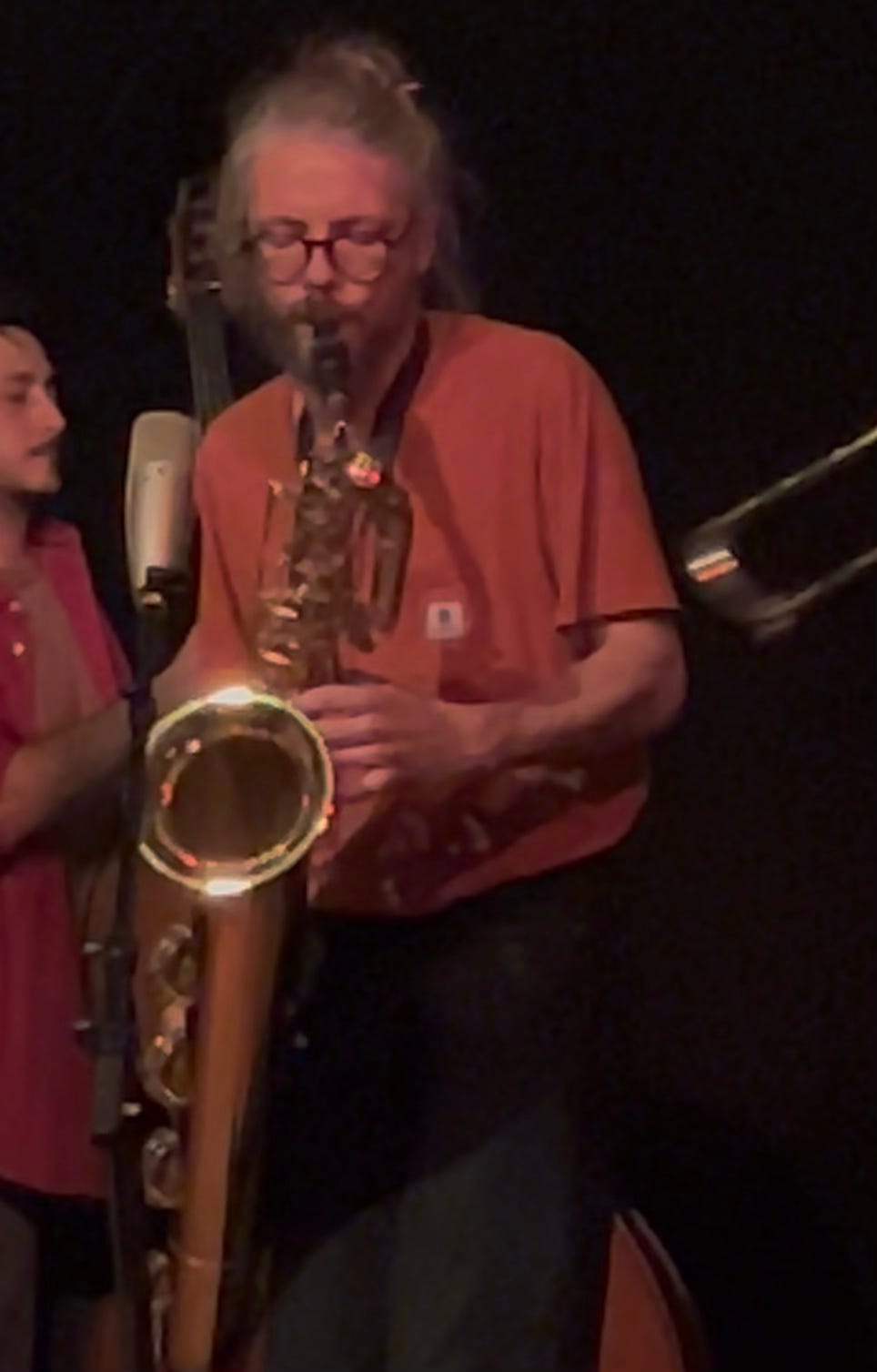
The first group was a special revelation for me as they were all new to me, other than drummer Michael Zerang. Shortly after they began, I was bewitched. Florian Nastorg was playing baritone saxophone, an instrument I have had great trouble liking thus far. He was playing it in ways I had never seen, generating a profusion of percussive noises, and tones that sometimes sounded like the sax’s gentler reed cousin the clarinet, sometimes like its more distant bowed relatives. He also used circular breathing, the technique that allows reed players to sustain notes indefinitely, using their cheeks to keep the air moving while they steal breaths. I had in the past seen this pretty much as a flex, a way of being even bigger on stage. Not here: at one point Nastorg created a drone with this technique, while the main musical interest was the beat produced by rhythmic whacking of keys: it reminded me of nothing so much as Sarah Elstran’s Nunnery, moving toward one-man-band status, but in this case with no looper, or with the circular breathing operating in its place.
As I told Nastorg afterward, this was a performance that positively redefined the instrument for me. He turned out not to be from Chicago but visiting the area for a few weeks from Toulouse. Yoram Rosilio on bass was also French, though now residing in Vienna. He also brought a fresh sensibility, and at least one technique I’d never seen from an acoustic bassist, or any bassist, namely tuning down his lowest string, really tuning it down, so that it provided tones that sank almost beyond audibility while bowed. The other musicians were from the Chicago scene: Jeb Bishop on trombone and Zerang on drums. Bishop was wonderful but I’ll comment a little more on Zerang, who is a stalwart of the free scene but impressed me more deeply this time around.
The biggest thing I noticed last night was his body language, which has a kind of astonished delight about it—he seems often on the verge of just waving his arms wildly after making any kind of sound—he actually did this to sonic effect with the variety of notable bells and handheld cymbal-type instruments that he wielded alongside the traditional set. But his face never betrayed this kind of delight—the kind of thing that happens to me pretty constantly in a performance, as, for example, I find one of my collaborators picking up on an idea that I let slip into some accompaniment—that happened yesterday too.
Zerang, his eyes nearly always shut tight, seems in a very serious place as is body is at play.
Since my “Otherlands” writing, I’ve been thinking a lot about grooves and free improvisation, and this band had another take on the topic: twice as I remember, there were moments when the drums had been a bit in the background—allowing Nastorg to take up the percussionist role with the keys of the saxophone, for example, while Rosilio created a kind of in-and-out of focus swirl of low sounds. Then suddenly Zerang came in with an almost in-time groove, almost a traditional ride-cymbal-playing-time kind of jazz groove, which we suddenly realized was waiting to be there, slipping into place (groove!) in a set of textures that hadn’t seemed, until then, quite groove-able.
The second band had two great figures from the Chicago scene, both with many prior years of New York playing on their resumes. Russ Johnson on trumpet and Mark Feldman on violin were joined by Devin Gray, who is apparently still a New Yorker (as well as I was able to learn). I was familiar with Feldman, from having been honored to play with him myself, and I knew Russ Johnson from a variety of Chicago bands. Johnson began the set with Darius Jones-like full throated presence in the small space of the club. He has been playing with Feldman in Chicago for several years now, and I noticed ways their vocabularies were able to mesh, with Johnson picking up on some of Feldman’s lightning-fast chromatic phrases, both of them ready to move from notes and pitches to sound effects, noises, wild gestures, and back without missing a step. Perhaps they also did this on their first meeting, but in any case, the speed and complexity of the conversation was remarkable to behold, like native speakers zooming forward in a language one has just started follow after years of study.
Devin Gray was another revelation. He was a burly presence at the instrument, but also was at times almost literally prostrate before it in a way that I hadn’t beheld before. There was a moment that I tried to capture where he had generated a sort of groove not-groove. It reminded me of some of the polyrhythmic textures Eric McPherson creates, but in this case I couldn’t hear any particular polyrhythms—it seemed more like a collection of pulses or unsteady pulses that somehow together were an entity. Meanwhile his body descended forward until his head was almost touching the floor tom, and at this point Feldman and Johnson were just letting the thing be, before finding a time to enter a little while after. I caught part of this on my phone.
Feldman a little later also used a technique that I had never encountered, which was to bow the violin on the wrong side of the instrument, above his fingers, reversing where the vibration is supposed to happen. He deployed this technique in response to a whisper-soft entrance from Johnson, who was using some potent trumpet mute, that almost silenced the instrument entirely. Feldman’s technique made him sound like a toy violin played backstage. Feldman also at other moments bowed the strings above the fingerboard, and also below the bridge—but I’d heard folks do that before, and indeed had tried it myself. It had never occurred to me to do the other reversal though. Will try later today. I was also happy to see him use this squeaking sound that he gets by breathing on his hand and rubbing it vigorously on the back of the violin. Huh.
Both sets were not really sets, in that they were both one long improvisation. OK, that’s not quite right: the first band played for maybe 45 minutes, and then did another 5 minutes before calling it. The second set was one uninterrupted motion.
So: “big” music—like Paul McCartney at the United Center—where I will be this evening. I don’t want to knock big music. But holy cow: last night at the Brain was basically an international music festival of madly accomplished, unstoppably innovative players pursuing things as far as they could in front of devoted listeners. Door price: $15. Cocktails: excellent. And no attempt to upsell you on the rye.
PS: McCartney was epic as well. Not knocking the “big” music at all. Also, not $15.